

You have the location, the data center blueprints, and an ambitious timeline to deploy. But if you haven’t secured your power path, you’re building a house of cards.
We all know the scenario: The massive AI and data center load request hits the utility, and the timeline instantly shifts from "Next Year" to "Five Years." Grid capacity is the ultimate bottleneck in modern development. Treating it as an afterthought is a mistake that will destroy your project's IRR.
Grid integration is no longer a checklist item; it is the foundation of your project viability. To move faster than the grid, you need predictive intelligence, not reactive planning.
At WATT Consultants, we don’t just model systems; we build strategies to crush delays.
We mapped out the entire high-speed timeline to power your next project. This isn't just theory—it’s how we win the race for capacity.
Continue reading for the details of "The Need-to-Know Grid Timeline for Data Centers".
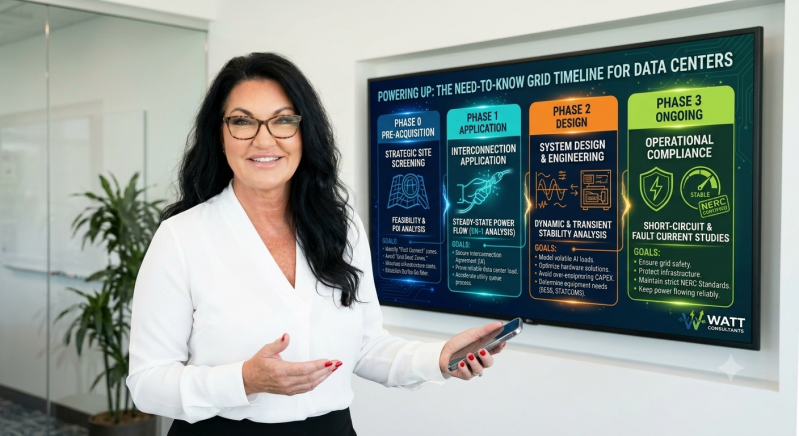
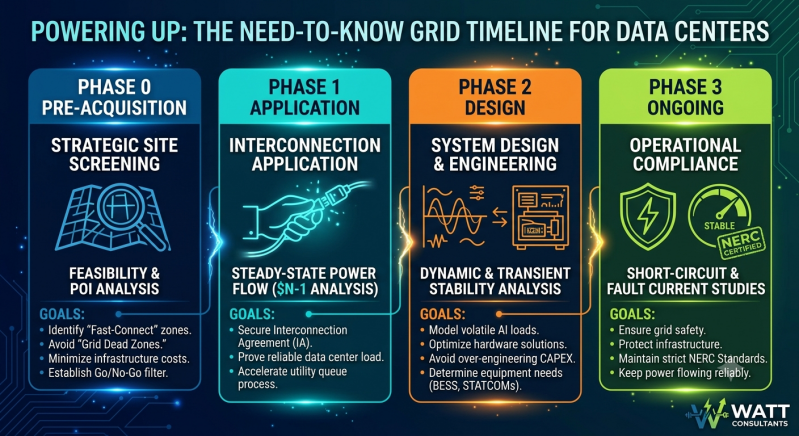
This timeline isn't just a best-case scenario; it’s the only path to reliable, fast interconnection for high-density loads. Here is the WATT Consultants breakdown of how we execute at every phase.
Phase 0: Pre-Acquisition — Don’t Invest in a Dead Zone
This is the Go/No-Go filter that developers skip at their peril. We use high-speed Strategic Site Screening to find the "hidden pockets" of transfer capacity. We look for existing infrastructure that can support hundreds of megawatts with minimal upgrades. Don't gamble your capital on a site that will require 20 miles of new 345kV line—find the fast-connect zone before you sign the lease.
Phase 1: Application — Prove Your Reliability to the Grid
The application process is where projects go to stall. You are in a queue with dozens of other developers, and the utility is legally required to study all of them. To break away from the pack, you need a flawless Steady-State Power Flow study. WATT Consultants proves, beyond a shadow of a doubt, that your load will not over-temperature their lines or violate voltage standards. A clean study at this phase translates directly into a faster Interconnection Agreement.
Phase 2: Design — Engineering the AI Shockwave
Traditional data centers are static loads. AI workloads are highly dynamic and volatile, creating an 'AI Shockwave' when they ramp up. This isn't something your standard steady-state model can capture. We conduct advanced Dynamic & Transient Stability Analysis to ensure the grid doesn't collapse during a momentary trip. This study tells us if you must procure specialized stabilization equipment, like a Battery Energy Storage System (BESS) or STATCOMs. Knowing this early lets you negotiate procurement costs into your Initial CAPEX budget.
Phase 3: Ongoing Compliance — Guarding the Flow
Your facility is online, but the work isn't done. The grid is constantly evolving. A new generator coming online miles away can change your fault current calculations. We use Short-Circuit Studies to confirm that your safety equipment remains rated for the available energy and that you maintain strict NERC compliance. This protects your facility, your equipment, and your license to operate.
Summary: WATT Consultants Turns the Grid into an Advantage
The rules of the grid are changing. The race for AI power is unforgiving to those who wait.
By integrating grid intelligence at Phase 0, you aren’t just conducting a study—you are de-risking your investment, optimizing your hardware strategy, and command-and-controlling your path to power.
We built this timeline because we believe the energy transition should accelerate innovation, not slow it down. We provide the predictive roadmap you need to plug in, stay safe, and scale fast.
Is your data center project positioned for success, or is it idling in the queue?
Let's discuss how WATT Consultants can build the powerful strategy that gets your next facility connected. Contact Us to Start Your Grid Feasibility Study Today.
Add comment
Comments