

The Power Paradox: How AI Demand, Regulatory Urgency, and Storage are Rewriting the Grid Playbook
The energy sector is currently caught in a fascinating, high-stakes paradox. On one hand, we are witnessing an unprecedented surge in digital infrastructure development, led by AI and hyperscale data centers, demanding massive amounts of power *right now*. On the other hand, we are operating on a physical grid and a regulatory framework built for a completely different era—one characterized by slow, predictable load growth.
We have officially moved past the point where "interconnection delays" are just a line item on a risk assessment. They are now the central bottleneck defining energy technology, project finance, and federal policy.
To understand where the market is moving, we have to look at how three massive shifts—the AI capacity crunch, looming federal regulations, and the absolute necessity of energy storage—are converging to rewrite the energy playbook.
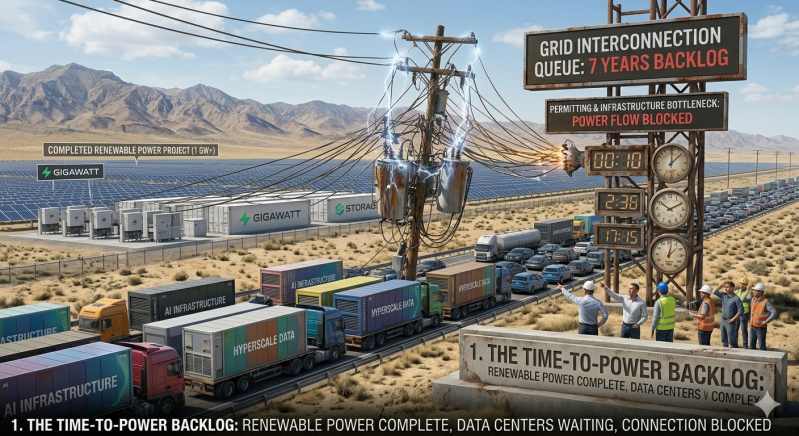
- The "Time-to-Power" Bottleneck: Real Estate is Secondary to Megawatts
- For decades, tech sector site selection was dictated by proximity to fiber optic lines, tax incentives, and real estate availability. Today, those factors are secondary. The only metric that truly matters is **Time-to-Power**.
- With traditional utility interconnection queues stretching out five to seven years in some regions, hyperscalers are hitting a physical wall. A data center can be built in 18 to 24 months, but waiting nearly a decade for the infrastructure to turn the lights on is an existential threat to the pace of AI innovation.
- Because of this, the industry is shifting from a centralized mindset to a localized one. Developers are increasingly exploring "behind-the-meter" (BTM) configurations and co-locating directly with existing power plants. If the grid can’t bring the power to the project, the project has to go to the power.
- The Regulatory Clock is Ticking: FERC Confronts the "Large Load" Crisis
- This shift toward massive, hyper-localized power demand hasn't gone unnoticed by regulators. The Federal Energy Regulatory Commission (FERC) is under immense pressure to standardize how these unique, high-impact loads interact with our interstate transmission system.
- The regulatory timeline is moving fast:
- The June Baseline: Following the Department of Energy’s Advance Notice of Proposed Rulemaking (ANOPR) under Docket No. RM26-4-000, FERC has committed to taking decisive action by the end of June to establish federal standards for processing large-load interconnections (generally defined as 20 MW+).
- The RTO Response: Regional grid operators aren't waiting around. We’ve already seen the Southwest Power Pool (SPP) roll out its High Impact Large Load (HILL) protocols, and PJM has been aggressively reworking its tariff rules to create transparent pathways for co-located generation.
- The core of the debate comes down to equity and cost causation. If a massive data center hooks up to a local system, who pays for the massive network upgrades required to keep the grid stable? A joint coalition of RTO state governors and the National Energy Dominance Council have made their position clear: large loads must bear the infrastructure costs of their own growth rather than shifting the burden onto everyday retail ratepayers. The upcoming FERC decisions will dictate the economic viability of large-scale energy projects for the next decade.
- Storage is No Longer Optional: Building the Flexible Portfolio
- As large loads place higher demands on the system, and as more intermittent renewable generation comes online, the resulting market volatility has made one thing clear: **energy storage is no longer a project optimizer; it is a grid necessity.
- We are seeing a profound shift in developer strategy. The goal is no longer just about adding raw nameplate capacity to the grid; it is about building *firm, flexible portfolios.
- With battery supply chains stabilizing as manufacturing resource allocation shifts from electric vehicles to grid-scale storage, the economics of hybrid architectures have fundamentally changed. Microgrids paired with utility-scale storage are becoming the primary mechanism to "firm and smooth" power delivery. Whether it's helping a co-located data center manage its net injections to comply with strict new RTO tariffs, or allowing a developer to capture value during periods of negative pricing, localized flexibility is the new currency of the energy market.
THE BOTTOM LINE:
The energy transition is no longer just a story about sustainability; it is a story about adaptability.
The companies that thrive in this environment will be the ones that understand how to navigate this trifecta. You cannot solve the AI capacity crisis without understanding the evolving FERC and RTO cost-allocation rules, and you cannot build a regulatory-compliant, fast-tracking project without embedding intelligent, flexible storage into the design from day one.
The grid is changing in real-time. The only question is whether project strategies are changing fast enough to keep up.
Add comment
Comments